The wall behind the TV decides the whole job. Most La Jolla Shores and Bird Rock homes built after the 1960s have wood studs on 16-inch centers, which take a lag bolt straight into framing and hold a 65-inch TV, around…
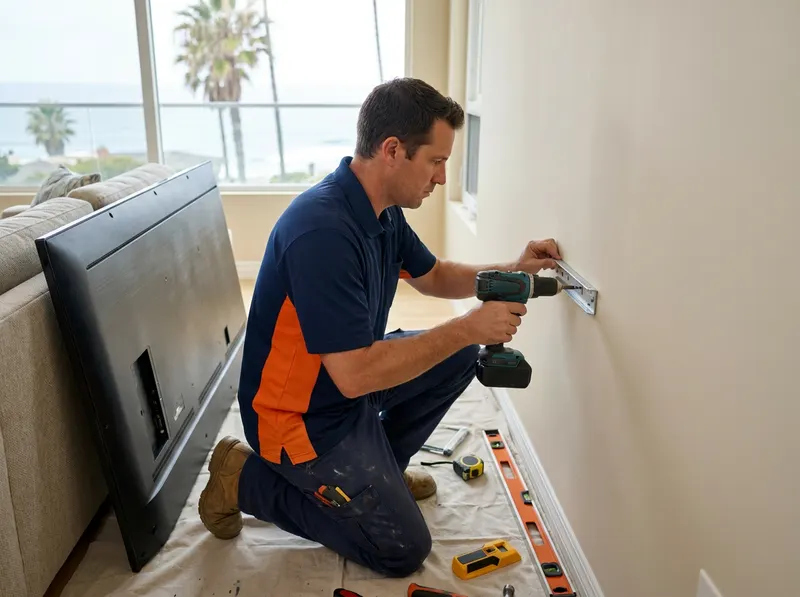
The wall behind the TV decides the whole job. Most La Jolla Shores and Bird Rock homes built after the 1960s have wood studs on 16-inch centers, which take a lag bolt straight into framing and hold a 65-inch TV, around 45, 60 lbs, without added anchors. Many La Jolla Village mid-rise condos and newer Hidden Valley units use metal studs or drywall over concrete; those need toggle anchors or masonry fixings, and a mount into bare drywall alone will fail under a large panel. A stud finder plus a quick pinhole check confirms the wall type before any bracket goes up. The OSHA fall-protection standard 1926.501 governs any ladder work above 6 feet, which applies on the tall entry walls common in Muirlands and La Jolla Alta homes.
Mount type follows the room. A fixed low-profile bracket sits about 1/2 inch off the wall and suits a TV at seated eye level in a Windansea living room; a tilt mount angles the screen 5, 15 degrees down for a bedroom or a wall above a fireplace; a full-motion arm swings out up to 20 inches for a corner or a galley kitchen in Lower Hermosa where you watch from two directions. The trade-off is simple to picture: a fixed mount is thinner and cheaper, a full-motion arm costs more and needs two studs to carry the leverage. VESA hole patterns on the back of the TV, commonly 200x200mm up to 600x400mm, must match the bracket, so the model or a photo of the back panel helps confirm fit before the visit.
Cable management is the second half of most mounts. Where an outlet already sits behind the screen, cords route through a paintable surface channel or, on a hollow wood-stud wall, through a pair of low-voltage brackets that pass HDMI and power cables inside the cavity. Running new line voltage inside a wall is electrical work under the National Electrical Code (NFPA 70) and is kept separate from the mounting labor. Homes near the coast in La Jolla Farms and Bird Rock see salt-air corrosion on exposed fasteners, so stainless or zinc-coated hardware is used on garage and patio-adjacent walls. Anchor ratings follow the manufacturer's stated pull-out load; a toggle rated for 50 lbs in 1/2-inch drywall is not a substitute for hitting a stud on a heavy TV, a point the CPSC Anchor It furniture-tip-over program reinforces for households with children.
A typical visit runs in order: 1) confirm the wall type and mark the studs, 2) set the bracket height and level it, 3) drill pilot holes and drive the anchors, 4) hang the TV or shelves and test the load by hand, 5) dress the cables. Floating shelves follow the same logic, a 36-inch oak shelf loaded with books carries real weight, so its concealed bracket is lagged into framing, not drywall alone. For picture-ledge and lightweight display shelves in a La Jolla Village hallway, rated wall anchors are enough.
Every job gets a firm, written price after a free on-site visit.
For standards, safe disposal, and service guidance on Handyman in La Jolla, CA, useful references include U.S. EPA, ENERGY STAR, U.S. Dept. of Energy, Consumer.gov, U.S. Census Bureau, and Google Maps. General consumer and small-business resources are available from USA.gov, Better Business Bureau, FTC Consumer Advice, U.S. Small Business Administration, and Ready.gov.
Tell us about your tv & shelf mounting job in La Jolla and we'll send a clear, written quote, usually the same day.
 Handyman La Jolla